BACKGROUND
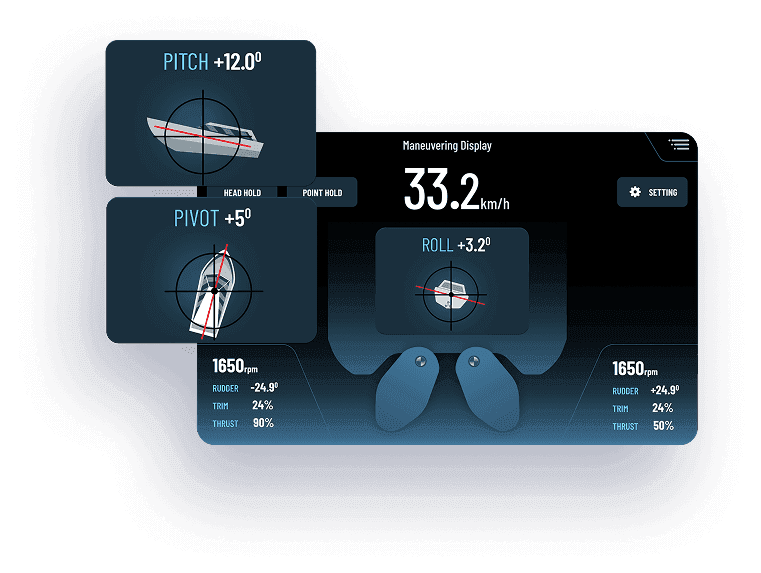
A leading global marine boats and outboards manufacturer partnered with Robosoft to replace their conventional analogue gauges with a next-gen HMI. This HMI features a fully connected ecosystem spanning the Multi-Function Display (MFD), iPhone, and Apple Watch. Robosoft conducted deep research and engineering to unite all three devices through an MQTT middleware layer into a single, seamless experience. The goal: make marine operations smarter, safer, and more intuitive for the people on board.
THE CHALLENGES
Addressing the
critical gaps

Translate continuous NMEA 2000 engine telemetry into clear, intuitive visualizations that operators can interpret instantly during vessel operation.

Replace multiple analog gauges with a responsive, touch-enabled command center designed for real-world marine conditions.

Consolidate data from independent engine systems, navigation sensors, and environmental inputs into one coherent interface without conflict, lag, or information overload.

Operators needed full vessel data access from an iPhone anywhere on board, and critical alerts on an Apple Watch, requiring a robust, real-time cross-device architecture.

The iPhone app required nautical charts, AIS vessel tracking, offline-capable weather data, health monitoring, and proactive safety alerts.

The architecture needed to be modular and extensible to support new sensors, hardware upgrades, and evolving marine standards without ground-up redevelopment.
THE CHALLENGES
Addressing the
critical gaps
Translate continuous NMEA 2000 engine telemetry into clear, intuitive visualizations that operators can interpret instantly during vessel operation.
Replace multiple analog gauges with a responsive, touch-enabled command center designed for real-world marine conditions.
Consolidate data from independent engine systems, navigation sensors, and environmental inputs into one coherent interface without conflict, lag, or information overload.
Operators needed full vessel data access from an iPhone anywhere on board, and critical alerts on an Apple Watch, requiring a robust, real-time cross-device architecture.
The iPhone app required nautical charts, AIS vessel tracking, offline-capable weather data, health monitoring, and proactive safety alerts.
The architecture needed to be modular and extensible to support new sensors, hardware upgrades, and evolving marine standards without ground-up redevelopment.

THE ROBOSOFT SOLUTION

A structured six-phase process from marine protocol research, hardware procurement, and NMEA network setup (Phases 1–2), through GUI implementation and data simulation (Phase 3), camera streaming feasibility (Phase 4), a fully functional NMEA pipeline prototype (Phase 5), to the complete multi-device rollout with iPhone, Apple Watch, and MQTT middleware (Phase 6).

Before engineering began, we conducted a thorough study of marine data protocols, hardware options, and the device ecosystem to ground every decision in the realities of marine operating environments.

We built and simulated a complete NMEA 2000 network, enabling rigorous testing of data decoding, rendering accuracy, and system behavior before deployment on actual hardware.

We developed the MFD HMI iteratively using N-Design, evaluating EXOR and JMobile toolchains, with CAN-based validation and a dedicated debug screen to verify NMEA 2000 and mobile data consistency.

We built native iOS and watchOS apps connected to the MFD through a Mini PC MQTT middleware hub. This enabled secure, real-time bidirectional communication across all three devices.
THE ROBOSOFT SOLUTION
A structured six-phase process from marine protocol research, hardware procurement, and NMEA network setup (Phases 1–2), through GUI implementation and data simulation (Phase 3), camera streaming feasibility (Phase 4), a fully functional NMEA pipeline prototype (Phase 5), to the complete multi-device rollout with iPhone, Apple Watch, and MQTT middleware (Phase 6).
Before engineering began, we conducted a thorough study of marine data protocols, hardware options, and the device ecosystem to ground every decision in the realities of marine operating environments.
We built and simulated a complete NMEA 2000 network, enabling rigorous testing of data decoding, rendering accuracy, and system behavior before deployment on actual hardware.
We developed the MFD HMI iteratively using N-Design, evaluating EXOR and JMobile toolchains, with CAN-based validation and a dedicated debug screen to verify NMEA 2000 and mobile data consistency.
We built native iOS and watchOS apps connected to the MFD through a Mini PC MQTT middleware hub. This enabled secure, real-time bidirectional communication across all three devices.

Clear outcomes
that drive growth

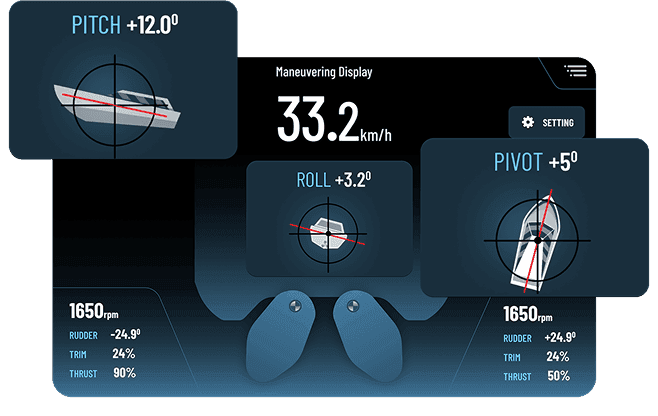
Robosoft delivered a fully functional, multi-device HMI prototype, spanning MFD, iPhone, and Apple Watch. We demonstrated the complete connected marine experience from MFD to wrist.

The solution moved the client from conventional gauge-based interfaces to an intelligent, connected HMI ecosystem. They now set a new standard for how boaters interact with their vessels.

Six phases of research, simulation, and iterative engineering created a reusable foundation, enabling the client to accelerate future marine digital innovations from a position of proven capability.

The modular, extensible architecture supports new sensors, hardware, and connectivity advances across future product lines, without starting from scratch.
Build automotive experiences that win in the market